Nothingness
Sometimes I wonder what will become of me.
I suppose this is one of the most fundamental questions a person can ask. It is certainly a question that many of history's greatest philosophers have wrestled with.
The self. The ego. Consciousness. Being.
I find myself returning to these ideas often. What will my final chapter look like? Will I make an impact on the world? On my family? Will I leave behind something meaningful?
I hope reality treats me kindly. In return, I try to treat myself kindly by making time to reflect, to think, to learn, to eat well, and to exercise. I do these things in the hope that I will wake to see another day, free, healthy, and at peace.
A healthy mind and spirit are worth more than wealth. Suffering is unavoidable, but good health lessens at least one part of that burden. It allows us to carry the rest a little more gracefully.
Still, there is something unsettling about knowing that, regardless of what we accomplish, our fate is inevitable. No one escapes it. Death is the one certainty we all share.
I find that both beautiful and deeply unsettling.
Sometimes I become so absorbed in these thoughts that I forget they are only speculation. I spend too much time living in imagined futures or replaying the past that I neglect the only thing that truly exists: this present moment.
Ironically, I often tell my friends and family not to worry about the future. Why waste today's energy on events that may never happen?
The advice is sound.
Yet I struggle to follow it myself.
We cannot know what tomorrow holds until tomorrow becomes today. Until then, every fear and every hope remains an invention of the mind.
Too often I rush from one task to another without stopping for a single breath, a single moment of appreciation. Perhaps that's why I'm writing this now. This is my pause. My moment to reflect. My moment to appreciate the privilege of being alive and the people who continue to walk beside me.
For weeks I've felt as though I'm observing a world that almost doesn't exist.
My eyes are merely lenses, watching an endlessly replaying film filled with different scenes, characters, and stories. Yet if something were to happen to this body, I would no longer witness any of it.
Life, however, would continue exactly as it always has.
That thought led me somewhere else this morning.
What will life look like one hundred years from now?
The Romans couldn't imagine airplanes. The Egyptians couldn't imagine electricity. Every civilization believed it was living in the most advanced era imaginable because it knew nothing else.
Perhaps we are no different.
One day our technology may appear as primitive as theirs does to us.
I've watched restored footage from the early 1900s. Children stare curiously into the camera. Elderly men and women glance at the lens without realizing that, over a century later, strangers would still be watching them.
Every one of those people is gone.
Yet for a brief moment, they still live through those recordings.
I find that fascinating.
It makes me wonder what people one hundred years from now will think when they look back at us.
Will my descendants still be here? Will anyone remember my name? Will stories of my life survive for another generation or two before disappearing entirely?
Eventually, I will also cease to exist.
I think our minds naturally create narratives about an afterlife, heaven, or reincarnation because the alternative is incredibly difficult to accept. The idea of absolute nothingness feels almost impossible for the human mind to comprehend.
Yet I find myself believing that nothingness is the most probable destination.
People often say that sleep is the cousin of death.
There is something strangely comforting about that comparison.
When we sleep, consciousness simply fades. Our muscles relax. Our awareness disappears. Time passes without our participation.
Death feels like the same process, except consciousness never returns.
Once the heart stops, blood no longer flows, and the body can no longer sustain itself, what remains?
Nothing.
Not punishment.
Not reward.
Simply the absence of experience.
Darkness.
Oddly enough, I'm at peace with that possibility.
If there truly is no return ticket, then this life becomes infinitely more valuable.
Reincarnation is a beautiful idea, but I have yet to see convincing evidence that it exists.
And if I'm honest, if someone asked whether I wanted to live this life all over again, my answer would be no.
Life is an incredible privilege, but it is also filled with immense suffering. I have witnessed enough cruelty, injustice, and heartbreak to know that I wouldn't willingly sign up for another lifetime of it.
Perhaps that's why I struggle with the traditional idea of heaven.
An eternal existence sounds exhausting.
Infinite time is difficult for me to imagine.
And if humanity remains humanity, would all the ignorance, hatred, arrogance, and division simply continue forever?
That thought feels far less comforting than peaceful nothingness.
To exist forever...
To do what?
Simply exist?
Eat. Sleep. Repeat.
Without challenge, without endings, without purpose.
What meaning would eternity even hold?
So I don't know what the future looks like.
I hope I remain here long enough to witness some of the good that humanity still has to offer. I know suffering will always exist, but perhaps I can lessen a small part of it for myself, my family, and those I care about.
If I can leave the world having reduced even a little suffering, then perhaps I've done enough.
As grateful as I am to be alive in this moment, I cannot help but wonder what waits beyond it.
What exists in the darkness?
What lives within the abyss?
Perhaps...
Nothingness.
The Weight of Never Being Enough
A hundred times. After that, I lost count.
I lost count of how many times you've insulted me.
How many times you've disrespected me.
When I respond with that same intensity, that same energy, you always find a way to make it about yourself.
And if others saw that side of you, what would they think?
I imagine they would feel shame. Disgust.
They would struggle to recognize the person standing before them.
When you are angry, I become your enemy.
When you are sad, I become your comfort.
But when I succeed, when I grow, when the world is proud of me, you are disappointed.
When I am at my lowest, somehow the conversation always finds its way back to you.
I find that fascinating.
It's as though I will never be good enough.
Never worthy enough.
Never able to meet the standards you've created for me.
When you need me, I am there.
When you tell me I need to improve, I become more disciplined.
When you need support, I prioritize you.
When you need understanding, I offer it.
But where is that same grace in return?
When all I want is gratitude, what do I receive?
When all I want is care, what do I receive?
Nothing.
I receive the worst of you.
And somehow, you've found a way to use my deepest wounds to your advantage.
You convinced me that I was the problem.
Maybe I am flawed.
But at least I can recognize the worst parts of myself.
At least I can confront them.
At least I can change.
But is it ever enough?
I've become numb to your hostility.
I've learned to walk on eggshells, carefully choosing my words, hiding my feelings, trying to avoid becoming the target of your anger.
You have mirrored the very behaviors that once hurt me most.
And that is what frightens me.
Not knowing who you are anymore.
Not recognizing what you've become.
This anger consumes you.
It follows you everywhere.
The energy you bring into a room feels dark, heavy, overwhelming.
I do not want to engage.
I do not want to be near it.
I do not want to fear every word I say because it might trigger another escalation.
I do not want to feel as though my thoughts, feelings, and needs are somehow wrong.
I do not want to feel voiceless.
But today, I am scared.
I am scared of what this becomes if nothing changes.
All I have ever wanted is respect.
Not as a man.
Not as a partner.
Not as anything other than a human being.
You don't speak to strangers this way.
You don't speak to acquaintances this way.
You don't speak to those you claim to care about this way.
So why me?
Why am I the exception?
Why am I the one expected to endure it?
Why me?

Beauty in Routines
Tonight’s reflection is centered around routines.
The rebellious teenager I once was wanted nothing to do with rules, schedules, or routines. I never wanted to feel tied down by structure. Yet in my current life, I find that routines give me comfort. The predictability of them is actually pleasant.
I imagine many of us worry. I know I do. Much of what we worry about stems from fearing the unknown, whatever comes next, or the things beyond our control.
Routines are different. They rely on you and your schedule, not someone else's. Some routines become a part of who you are. Take going to the gym, for example. You may go several times a week, missing very few days. You know that tomorrow you'll wake up, get ready, and head to the gym, just as you've done for months or years. There is comfort in that consistency.
I used to avoid routines. I hated predictability. I was more spontaneous and carefree. I was the kid who dreaded cleaning his room, doing homework, studying, going to the gym, and just about anything that didn't involve listening to music or playing it.
At 35, I find myself enjoying the little things. As much as I dream about retiring early, sticking it to corporate America, and doing my own thing, I don't mind the life I've built. I don't mind work. I don't mind sweeping the floor or doing laundry.
In fact, I find those tasks relaxing.
Simple chores require your attention. They ask for your mental and physical presence, and in doing so, they pull you away from whatever else may be occupying your mind. In moments spent sweeping, packing my son's lunch, or washing dishes, I often find a sense of calm. Those small routines and tasks I perform every night, or most nights, have become a source of peace.
Zen Buddhists have a concept called samu, a form of working meditation. The idea is simple: fully engage in the task in front of you. Lean into what you're doing. Focus on it completely, no matter how ordinary it may seem. There is something meaningful about giving your full attention to even the most mundane responsibilities.
Not too long ago, I wrote about travel and my love for it. What I didn't talk about is how, three or four days into almost every vacation, no matter how much fun I'm having, I begin to miss home.
I miss my routine.
I could be in the middle of a dream vacation, visiting places I've wanted to see for years, and still find myself longing for home. I miss the comfort. I miss the familiarity. I miss the predictability.
Maybe I get homesick easily.
There's peace, or at least there should be peace, in every home. Home is where we take refuge from the world.
So what am I really trying to say?
After a long mental pause, I think it comes down to this: routines are essential to my life. That repetition, that familiarity, that steady process of doing what is in my nature to do, pursuing goals, and overcoming challenges, gives my life structure and meaning.
I think it's important that we occasionally stop and reflect. To reprioritize. To find joy in the smaller, more mundane tasks that make up so much of our lives.
Not everything is fun. Not everything is enjoyable.
But if there is purpose in doing it, then it is worth doing.
As I've gotten older, I've realized that routines are not the enemy of freedom. They create the foundation that allows us to live well. There is dignity in the ordinary: sweeping the floor, packing a lunch, washing dishes, showing up to the gym, and caring for the people we love.
We spend so much of our lives chasing extraordinary moments that we sometimes overlook the quiet beauty of the everyday. Yet it is often in those small, repeated acts that a meaningful life is built.
Worlds Within Worlds
I find travel to be one of life's greatest privileges. Few people are fortunate enough to experience the wonders that exist beyond their own corner of the world.
Travel has shaped many of my opinions. More importantly, it has allowed me to see myself outside of my comfort zone, outside of my natural habitat here in America.
I've often said that we live in worlds within worlds. Even our minds, the way each individual perceives life, are worlds of their own. There is something beautiful about that realization. It reminds me that we, as humans, are much smaller than we often imagine. Compared to the vastness of our planet, the cosmos, and the universe itself, we are little more than ants wandering through an incomprehensibly large existence.
I digress.
Travel is no longer a luxury to me. It has become a necessity. It is one of the ways I decompress, disconnect from routine, and experience the world unfiltered. I have visited places so ancient, so beautiful, and so humbling that I have come to believe that most people want the same fundamental things: to live, to love, to care, and to be free.
Over time, I realized that I need that change of scenery. While I respect that everyone is different, I have always struggled to understand why some people have no interest in seeing the world beyond what is familiar to them. Perhaps my curiosity is simply wired differently.
I have observed that a lack of exposure to different cultures often contributes to biases and assumptions about the world. I have participated in conversations with peers and strangers whose opinions about entire countries or cultures were built on stereotypes, media portrayals, or secondhand information rather than firsthand experience.
Travel has helped me challenge many of my own preconceived notions about cultures, religions, and countries. In some cases, my assumptions were wrong. In others, there was some truth to them. The lesson was not that stereotypes are always false or always true, but that reality is usually more complex than either extreme.
One idea I often find myself exploring is how societies determine what is acceptable and what is not. In Western culture, for example, we have established laws and norms around adulthood and the protection of children. In other parts of the world, those standards may be very different.
The point is not to debate specific examples. Rather, I find it fascinating that what many of us consider universal truths are not universally accepted. Our moral compass is not perfectly synchronized across cultures. What is considered right, wrong, normal, or strange often depends on where and how someone was raised.
Travel has forced me to confront that reality.
It has challenged my assumptions and made me question many of the beliefs I once accepted without scrutiny. Much of what we believe is shaped by religion, culture, upbringing, social norms, and, my favorite word, indoctrination.
Stepping outside of my world and into someone else's allows me to see reality through a different lens. It is almost like what people describe as an out-of-body experience, except I am still very much in my body. I am simply experiencing another world within my own.
I find that fascinating.
When someone tells me they have no interest in seeing the world, my immediate question is simple:
Why?
Not because everyone must travel internationally or spend thousands of dollars exploring distant countries. Rather, because there is something transformative about experiencing a culture, environment, or perspective completely different from your own.
One of my most memorable experiences occurred in Hong Kong.
My family and I took a cable car to visit the Tian Tan Buddha, commonly known as the Big Buddha. As we ascended the mountain, thick fog surrounded the gondola. The wind howled, the cabin swayed, and all I could see was our reflection in the glass. It looked like something straight out of a horror movie.
As the cable car shook, I briefly became convinced I might die that day.
Thirty minutes later, we arrived.
What awaited us was breathtaking.
After climbing hundreds of steps to reach the Buddha, I found myself staring across endless mountains, valleys, and forests. The fog slowly lifted as sunlight pushed through the clouds. Standing there, thousands of miles from home, I felt completely disconnected from my everyday reality.
For a brief moment, I forgot about work, responsibilities, and deadlines.
I simply existed.
We explored nearby temples, watched monks going about their daily routines, smelled incense drifting through the air, and watched koi fish glide peacefully through ponds.
At one point, I looked at my son and wondered:
Will he remember this?
Will he appreciate moments like these one day?
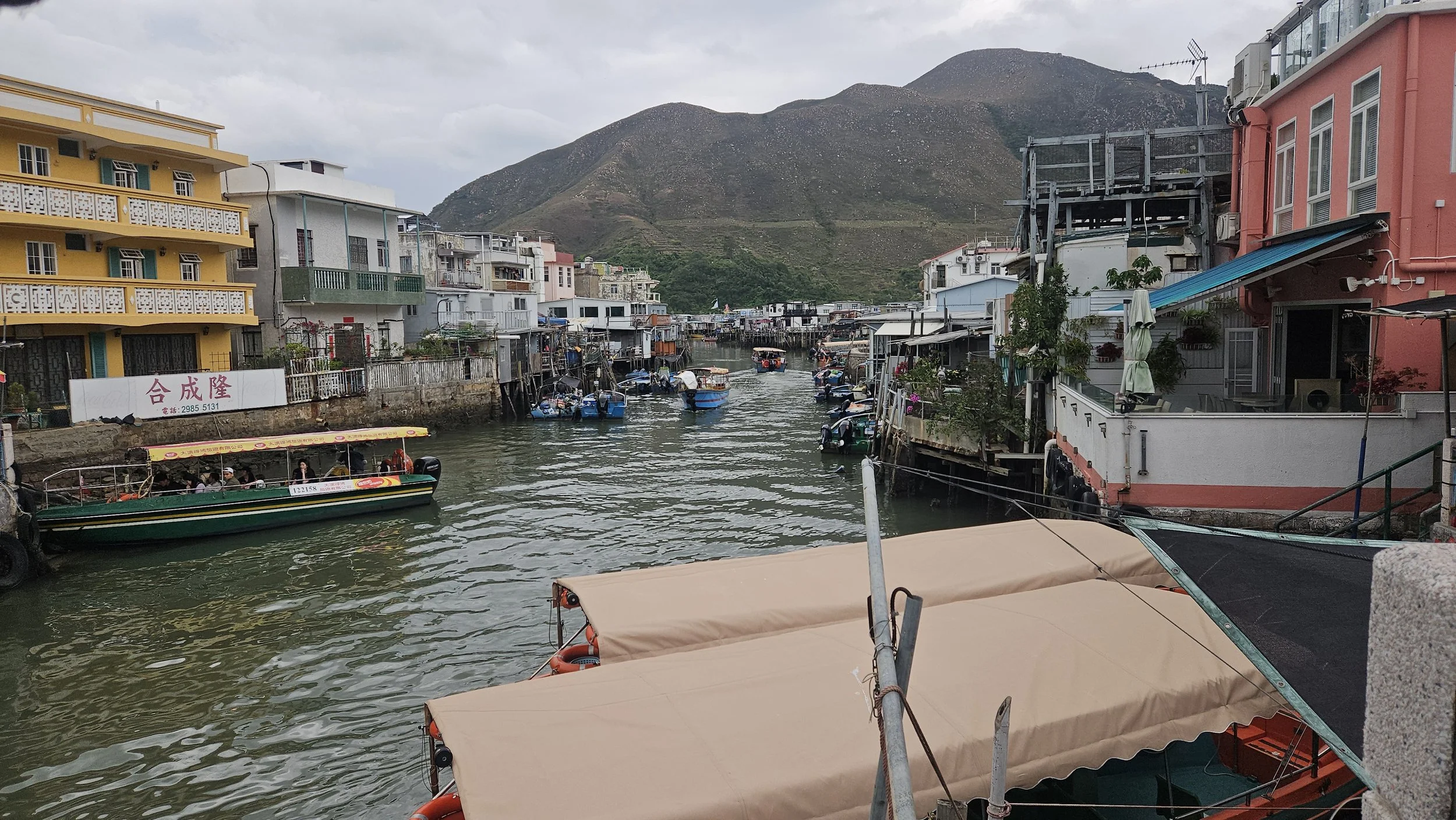
Later, we traveled to the fishing village of Tai O.
The journey itself felt like an adventure. We boarded a coach bus that raced down steep mountain roads with a level of confidence that was both impressive and mildly terrifying. Once again, I briefly considered the possibility that I might die that day.
Thankfully, I survived.
When we arrived, we wandered through the village and eventually signed up for a boat tour in search of the famous pink dolphins.
For twenty dollars, the three of us climbed aboard a small vessel and headed out into the water.
To my surprise, we found one.
After spotting movement in the distance, our captain quickly turned the boat toward a faint pink shape surfacing from the water. We never got the dramatic dolphin show you see at theme parks, but we saw it.
And honestly, it was one of the best twenty dollars I've ever spent.
What struck me most about Tai O was not the dolphin.
It was the people.
I watched fishermen working along the docks. I saw families living behind their shops. I saw locals laughing together outside modest homes built on stilts over the water.
Many had far less than the average American household.
Yet they seemed happy and satisfied.
They laughed. They socialized. They enjoyed one another's company.
I found myself wondering why so many people in the Western world, despite possessing more wealth and convenience than almost any generation before us, often seem so unhappy.
The people of Tai O reminded me of something important.
Happiness does not appear to have a strong relationship with excess.
The foundations of a meaningful life seem remarkably simple: love, connection, freedom, purpose, and community.
Those principles appear to transcend culture.
As I walked through the village, I realized that despite all our differences, people around the world are far more alike than we often assume.
We all worry.
We all hope.
We all love.
We all suffer.
We all search for meaning.
That realization may be the greatest gift travel has ever given me.
Travel does not require hopping on long flights, crossing oceans. It can be as simple as visiting a neighboring city, exploring a different community, or spending time with people whose lives look different from your own.
The goal is not distance.
The goal is perspective.
I truly believe that if we spend enough time observing others, listening to their stories, and stepping outside of our own worlds, we eventually begin to see ourselves in them.
Each stranger becomes a slight variation of ourselves.
Travel has taught me that there is a slower way to live. It has taught me that not everything requires urgency. Sometimes the greatest lessons are not found in schools, textbooks, or lectures.
Sometimes they are found in a quiet temple.
A fishing village.
A conversation with a stranger.
Or a moment spent looking out across a distant landscape, realizing that the world is far bigger, and far more beautiful, than we ever imagined.
Reflections on the Human Condition
The Curse of Awareness
Loneliness fills the mind of the deep thinker. His quest for profound understanding is nothing but a curse unto himself, a burden he neither agreed to accept nor intentionally pursued. The more aware and in tune with the world he becomes, the more troubled and puzzled he feels. With each new layer of knowledge gained, more questions arise, multiplying endlessly. He finds himself asking "why?" like an adolescent child hungry for clarity.
With deep wisdom comes clarity, but at what cost? Is this depth of thought sustainable? Or does it risk tipping the thinker toward madness? The haunting possibility of mental collapse shadows him. At times, he envies the ignorant, those who seem to walk in simplicity, blissfully detached from the labyrinth of thought.
The deep thinker does not possess all the answers. He seeks meaning for life's complexities. He wonders why others do not feel the same urgency to understand, to question, to reflect. Unlike the modern slave, he walks alone, often unintentionally excluded from the pack. He is out of step with his time and culture.
Depression
Depression is more than sadness. It is a profound disconnection from self, from life, and from purpose. During depressive episodes, the individual is rendered motionless, unmotivated, and often unrecognizable. Interests vanish. Hygiene, ambition, and speech, everything becomes a burden.
Depression is not always caused by a single event. It may stem from trauma, disillusionment, or an overwhelming awareness of reality itself.
The mind becomes both battlefield and prison. It is filled with demons, internal voices that mock, doubt, and accuse. It is important to face these demons, not to run from them. They are born of pain, yes, but also of truth. They reveal what we hide and what we suppress. In confronting them, we gain strength.
Healing begins with awareness. Cognitive Behavioral Therapy, or simply a commitment to self-analysis, can begin the process of rewiring the mind. Through this slow and deliberate practice, we begin to rise, to reframe pain, and to reclaim ourselves.
The Death of Innocence
The children suffer first.
They are born into systems that poison their minds, limit their dreams, and prepare them for war. They do not choose hatred. It is handed to them like a family heirloom.
We drop bombs and call it peacekeeping. We sanction nations into starvation and call it diplomacy. We let the innocent rot while the guilty rule.
Where is the God who allows this?
Where is the divine justice when children bleed, when hospitals are reduced to rubble, when rape is used as a weapon of war?
The answer is silence.
Isolation
He walks alone. Not because he wishes to, but because few understand him. His mind is both his sanctuary and his prison.
He cannot return to the simple joys. He cannot pretend. He cannot be numb. The parties, the small talk, and the petty arguments bore him. They drain him. He sees the charade and cannot participate.
He envies the blissfully ignorant, but cannot become them.
So he writes. He creates. He reflects. He speaks when he must, but only to those with ears to hear.
The Way Through
The only path out of depression is through it. Medication may help stabilize. Therapy may help reveal. But healing requires confrontation.
The individual must face the darkest parts of himself, his fears, his failures, and his illusions. He must grieve the world he thought he lived in and slowly build a new one, grounded not in fantasy but in truth.
It is a long, uneven road. But it leads somewhere real.
And in time, the thinker learns that depression is not the enemy. It is a teacher.
It teaches humility. Patience. Compassion.
And most of all, it teaches resilience.
Indoctrination of The Nation
Indoctrination
To me,
You should not allow yourself to become indoctrinated: whether through religion, philosophical
dogma, or the pull of herd mentality. Indoctrination is a blinder that etches itself into one’s
thoughts, into one’s very actions, until truth itself becomes obscured.
Instead, strive to remain fluid. Let your mind breathe, reason, and question freely. Do not turn
away from your darker thoughts…examine them. Understand why they arise. And remember,
not every thought demands an emotional reaction or a course of action. Some simply need to
be understood.
Sit with these thoughts in quiet reflection. Let them shape your inner world. Peel back the layers
of your beliefs, scrutinize them, challenge them. That is the only honest path toward
enlightenment.
We spend too much time debating scripture and allegory, and too little time embodying their
core principles. We’re so caught up in argument, in the need to be right, that we lose sight of
what truly matters: understanding. Even in opposition (contrast), there is something to learn. If
only we are humble enough to listen.
We seek to destroy others’ beliefs while reinforcing our own, yet the real work is inward. Be
willing to discard old ideas that no longer serve the truth. Let new insights take root. That is
growth.
Do not waste your energy arguing over things that may have never been, whether Jesus existed
or where Eden may have been found. These are distractions. Instead, live in accordance with
the values you speak of. Let your life be the testament. Otherwise, you risk being seen not as
wise, but as a hypocrite.
Anxiety Beyond Control
I want to be patient.
I want to breathe before I crash.
But sometimes I wonder
do I want patience
or do I just want control?
I’m always leading,
always directing the rhythm of the day,
as if silence means danger,
as if letting go means collapse.
Every ounce of discomfort
sets off alarms.
I get restless,
sharp,
short.
People feel me at my worst
and think it’s about them,
but it isn’t.
It’s the weight of my own unease,
the fight between control and chaos,
the panic of not steering the wheel
even when I don’t know where I’m going.
I don’t mean harm.
I’m just trying to manage
what feels unmanageable.
And maybe one day
I’ll learn that control
isn’t peace,
it’s the fear of losing it.
The Girl
The girl with the pretty eyes
sits quietly, watching me
a mystery written in grace,
a story I long to read.
Her gaze, soft yet full of fire,
awakens something deep
something that I wish to know,
to feel,
to keep.
She is someone to explore,
a mind of brilliance,
a heart that smiles.
Beauty beyond the surface
gentle, radiant, alive.
She is an artist
an artist of all that is beautiful,
though she does not see it.
She paints the world in light
without ever knowing
she is the light.
She is love,
unaware of her own divinity.
And I
I only wish to show her
that she is worth it,
that she is everything,
and more.
Freedom
Freedom
How I wish it were true,
this thing they call freedom.
An illusion that governs us,
a dream wrapped in chains.
I move through the cycle,
enslaved to routine,
yet I know
there is more to life
than this quiet obedience.
They say we need rules,
we need order,
for the average man
is drowning in indulgence.
But I
I do not need a ruler
to tell me how to live.
Freedom is not in permission.
It is in choice.
It is in truth.
To live by one’s own hand,
guided not by command
but by conscience
that is freedom.
That is order.
Evolving
There was a time when disrespect meant reaction.
When a stare, a shove, a word all of it was a call to war.
I learned that language young.
Where I came from, you didn’t back down.
You stood tall or you got walked on.
That’s what manhood meant, or at least what we thought it meant.
But now I see it different.
Now I’ve built something; peace, purpose, a name that means more than pride.
And that part of me is still there,
the part that still twitches when someone tries me,
he doesn’t need to swing anymore.
He just needs to breathe.
When that man threatened my life,
the old me wanted to step forward.
The new me stayed still; not out of fear,
but out of control.
Because I know what happens when pride wins and peace loses.
I’ve seen the inside of that story. I’m not interested anymore.
People might call that soft —
but softness doesn’t take that kind of strength.
It’s easy to throw a punch.
It’s harder to walk away and still hold your head high.
The boy from the block would’ve fought to prove something.
The man I am now fights to protect everything.
So no, I’m not soft.
I’m doing what is right for me.
Arguing With The Idiot
How challenging it is to argue with the idiot—
The idiot who believes he is enlightened,
Who clings to incoherent rants and conspiracy theories devoid of merit,
Yet speaks with the confidence of the informed.
You present logic. You bring facts.
But to the idiot, your reasoning is nothing more than propaganda—
A false narrative too foreign for his fractured worldview.
And to you, his worldview is a carnival of contradiction, a rejection of reason itself.
You stare in a mix of awe and disgust.
How does one reject science?
How does one deny centuries of collective knowledge
And still claim the title of "thinker"?
He does not stand alone.
He feeds off slander,
Off the approval of the like-minded herd
That mistakes volume for truth and outrage for insight.
Still, I remain hopeful.
Hopeful that time humbles the ignorant.
Hopeful that history, unforgiving as it is,
Exposes the lies they clung to as gospel.
But what becomes of the argument
When dialogue is a standstill?
How can we grow if we cannot learn from one another?
Where have empathy, right speech, and tolerance gone?
You cannot convince the idiot he is wrong.
And you cannot convince him that you are not the idiot.
It is a philosophical conundrum,
A hall of mirrors in the theater of delusion.
And perhaps, this is the greatest tragedy of being human:
To be so sure, and yet so blind
The Code of the Stoic Warrior: Honor, Wisdom, and the Path to Peace
Written for my son, Kai, this guide is a collection of principles to navigate life with courage, integrity, wisdom, and peace. It is not a set of rules, but a compass for becoming a good man.
1. Master Yourself
You control only your thoughts, actions, and reactions. Cultivate self-discipline, for true freedom arises from within. As the Stoics taught, "The only thing in your power is your own judgment."
2. Live with Integrity
Let your word be your bond. Be honest with yourself and others. Never compromise your character for convenience or gain. As Zen teaches, "Act without attachment, speak without deceit."
3. Embrace Wisdom, Not Knowledge
Knowledge is a tool, but wisdom is the application of knowledge. Seek to understand the nature of things, not to simply accumulate facts. In all things, "Know what you can control and let go of what you cannot."
4. Cultivate Inner Peace
The world will offer turbulence; you must find stillness within. As the Zen master said, "The mind is like water—when it is still, it reflects the truth clearly." Do not let the external world disturb your inner calm.
5. Accept What You Cannot Change
"It is not events themselves, but our judgments about them that cause us distress." Accept the impermanence of life, and find peace in the ebb and flow of circumstance. Control your response to the world, and let go of the illusion of control.
6. Pursue Virtue, Not Reward
Your actions must be guided by what is right, not by external outcomes or recognition. The Stoic says, "Do what is right because it is right, not for reward or praise." In every situation, ask yourself: “Is this just, honest, and honorable?”
7. Be a Man of Honor
Let your word, your actions, and your commitments define you. Uphold honor even when no one is watching, for the true measure of a man is what he does in solitude. "A man who does not honor himself, cannot honor others."
8. Find Strength in Adversity
The trials of life are the forge of a strong soul. In hardship, seek to grow, not to escape. As the Stoic Marcus Aurelius said, "The impediment to action advances action. What stands in the way becomes the way." Meet each challenge with courage and grace.
9. Be Present, Not Attached
Zen teaches us to live fully in the present, for only here do we truly exist. Let go of the past and the future, for they are both illusions. Be fully present in your actions, with no attachment to the result, for all things are fleeting.
10. Live Simply, Live Truly
Excess is the enemy of peace. Simplify your life and seek fulfillment not in material things, but in virtue, wisdom, and relationships. The Stoic practices restraint, for true wealth is the richness of character, not possessions.
11. Practice Compassion Without Weakness
Honor others with compassion, but never confuse kindness with complacency. Seek to help others not from a place of pity, but from understanding their shared humanity. Zen teaches, "When you give, give with a full heart—without expectation."
12. Seek Silence, for in Silence You Hear Truth
In the stillness of your mind, you will find clarity. Like the Zen master who sits in silence, so too must you find quiet moments to hear the whispers of wisdom. Do not be afraid of silence—it is the birthplace of insight.
13. Let Go of Ego
The ego is the greatest barrier to peace. Recognize that you are but one part of the vast whole. Be humble, for humility is the path to true strength. "Ego is the false self. True strength arises from knowing your place in the world and living in harmony with it."
14. Act with Justice, Not Favor
In all your dealings, let fairness guide you. Treat all men with respect, regardless of their status or wealth. Do what is just, not what is easy. Remember: "Justice is the highest form of virtue."
15. Prepare for Death, Live for Life
Contemplate your mortality often, for it is the only certainty. Let it not cause fear, but inspire action. Live with urgency, for every day is a gift. As the Stoics remind us, "Live as if you were to die tomorrow. Learn as if you were to live forever."
The Cruelty of Life
Life can seem cruel when viewed through suffering alone. This reflection questions whether pain is the nature of existence or simply a consequence of consciousness.
Life can be cruel. Even while we live, we move through shadows—moments of pain, confusion, and quiet suffering that remind us how fragile our experience is. It is easy, then, to imagine that what follows life is more of the same darkness.
But that assumption carries a flaw. Darkness, as we know it, requires awareness. It is something we feel, something we perceive. Without consciousness, there is no suffering, no fear, no sense of emptiness. There is not even darkness—only the absence of experience itself.
What follows life may not be a continuation of pain, nor a descent into some endless void we must endure. It may simply be nothing at all. Not darkness. Not light. Not peace, nor suffering. Just silence beyond perception.
And in that realization, something shifts. The weight of fearing what comes after begins to loosen. For if there is no awareness, there is nothing to fear. The cruelty of life belongs only to the living.
Fear
What I’ve learned is that survival in this life is not about becoming someone else, but about mastering the many versions of yourself that existence demands. A man who cannot adapt is broken by the world. A man who adapts without losing his soul becomes dangerous in ways most people will never understand.
There will be moments when you must step into conversations you do not wish to have, stand before people who disturb your peace, or face rooms that awaken fear within you. In those moments, build your script. Follow your code. Not as deception, but as discipline. The actor who survives does not forget who he is, he simply learns which part of himself must rise to meet the moment.
Like the chameleon shifting its colors beneath the sun, or the octopus dissolving into its surroundings before a predator, wisdom often hides itself in calmness. Adaptation is not weakness. It is one of nature’s oldest forms of intelligence.
And never reveal to your enemy that they have shaken you.
The world feeds on visible fear. Some people seek power not through truth, but through the disturbance they create in others. Do not offer them your spirit as proof of their strength. The person who gives you anxiety, the challenge that terrifies you, the crowd staring as you speak, all of them must be faced with the same quiet awareness. Breathe. Observe. Endure. Call upon the ancient survival buried within you.
The Stoics understood this deeply: true power is not loud. It is composed. It is grace under pressure. It is kindness without surrender. It is firmness without hatred. A mind ruled by emotion becomes a prisoner to every insult, every opinion, every storm. But a disciplined mind becomes untouchable.
To remain unshaken before your greatest enemy is to destroy the illusion of their power. To remain standing before your darkest challenge is to silence the demons within that whisper you are weak, worthless, or incapable. Most battles are not fought in the world outside of you, but in the hidden chambers of the mind.
Do not allow yourself to be burdened by the shallow interpretations of others, by their bitterness, their projections, or their need to define your worth through their limited understanding of grace. Many people wish to mold you into a version of yourself that comforts them. Refuse it.
Your path belongs to you alone.
At the end of all things, you are the one who must carry your thoughts, your choices, your burdens, and your truth to the grave. So walk your journey with discipline. Speak carefully. Endure silently when needed. Adapt without surrendering your soul.
And remember: the strongest people are not those who never feel fear, but those who refuse to let fear become their master.